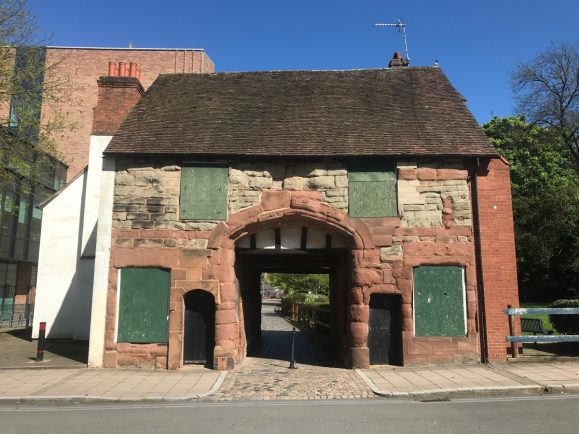
A FORMER Grade II listed toy museum in Coventry city centre is to receive a facelift by Historic Coventry Trust.
The trust plans to fully restore Whitefriars’ Gate in Much Park Street, which has remained vacant since 2007 and been slowly deteriorating since then.
Currently listed on Historic England’s 2020 Heritage At Risk Register, the charity plans to convert it into visitor accommodation and a small office unit.
An initial grant of £100,000, awarded by The Architectural Heritage Fund (AHF), under its Transforming Places through Heritage Programme will allow the project to progress.
Graham Tait, assistant director at Historic Coventry Trust, said work was underway to secure the remainder of the funding and finalise planning permission to breathe new life into this disused historic and much-loved building.
He said: “We are currently developing a detailed design to convert Whitefriars’ Gate into visitor accommodation as well as utilising the building extension – the remains of the adjacent Rose Tavern – for commercial use as offices or retail.
“This positive support from the Architectural Heritage Fund is a great boost for the project.”
Ron Morgan, a potter and former city councillor, was the building’s last resident. His love of children’s toys led him to open the building as a museum from 1973 until 2007. It is still affectionally known by many people in Coventry as the Toy Museum.
Part of the red sandstone building suffered fire damage in 2008 and was subsequently repaired.
Whitefriars’ Gate was built in the late 14th Century as the secondary gatehouse of the nearby Carmelite Friary, Whitefriars Monastery – the remains of which are on the eastern side of Coventry’s ring road.
After the dissolution of the friary in 1538 it was adapted into two separate cottages. Adjacent was the 16th-century Rose Inn.
During the Second World War Much Park Street suffered bomb damage, leaving the Whitefriars gatehouse and its later extensions standing isolated in this part of the street.
The AHF is supporting 10 to 15 capital projects across England which restore and bring new uses to historic high street buildings in a £15 million three-and-a-half-year programme funded by the Department for Digital, Culture, Media & Sport.
Chief executive Matthew Mckeague said: “This project demonstrates the value heritage can have in regenerating our town centres and high streets – and the unique role charities and social enterprises play in finding new uses for historic buildings like Whitefriars.”